Shopping for an AK can? Most 7.62×39 AKs use M14x1 LH threads, and AK-74s use M24x1.5 RH. A .30 caliber can with the right mount works well. Check alignment, since AK muzzles vary.
Here’s how the suppressed AK got its start.
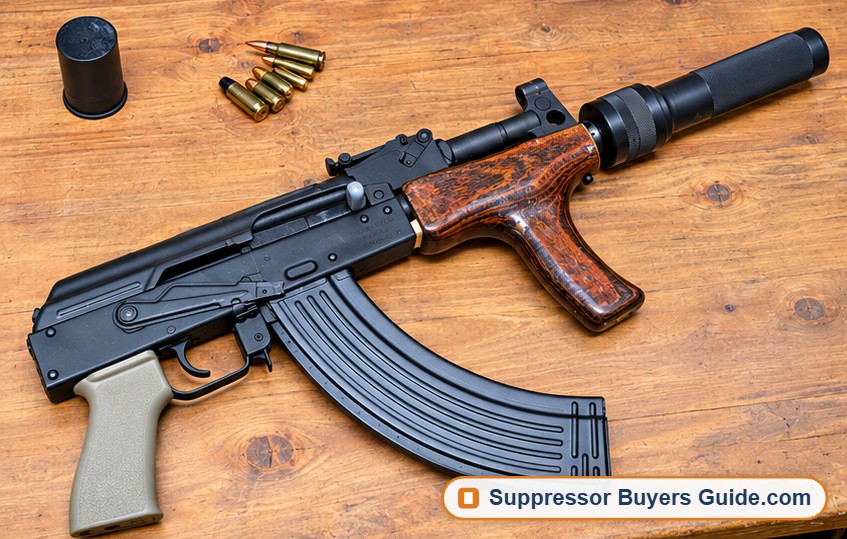
The Kalashnikov rifle was never originally designed around suppressed fire. Its priorities were reliability, simplicity, durability and mass production. Even so, Soviet military planners recognized fairly early that the AK could become a useful platform for reconnaissance troops, special operations forces and other units that needed to reduce the sound and visible signature of gunfire.
Before the Suppressed AK
Soviet forces used suppressed Mosin-Nagant rifles fitted with devices such as the Bramit suppressor.
Development of a suppressor for Soviet 7.62×39 weapons began during the mid-1950s at NII-61, the research organization that later became associated with TsNIITochMash. Early work was intended to support several weapons, including the AK, SKS and RPD.
Original PBS
The first major Soviet system became known as the PBS, short for Pribor Besshumnoy Strelby, generally translated as “Device for Silent Shooting.”
Early PBS designs appeared in the late 1950s. One unusual version used a hinged or clamshell body that could be opened for cleaning and maintenance. Although innovative, the design was relatively complicated and did not become the long-term solution.
Approximately 100 of these early suppressors were reportedly produced before development moved toward a more conventional cylindrical design. Production responsibility shifted to the Izhevsk manufacturing complex in the early 1960s.
PBS-1
The suppressor most closely associated with the classic Soviet AK is the PBS-1.
Introduced during the 1960s, the PBS-1 was developed primarily around the 7.62×39 AKM and AKMS. It replaced the earlier clamshell concept with a conventional tubular suppressor that was stronger, simpler and better suited to military service.
The PBS-1 was not simply a modern-style suppressor screwed onto a standard rifle. It was part of a complete suppressed weapon system that included specialized subsonic ammunition. One of the major engineering problems was getting a Kalashnikov to cycle reliably while firing ammunition producing substantially less pressure than ordinary military ammunition.
The Soviet solution included an internal rubber obturator, commonly described as a wipe, along with a series of internal baffles. The suppressor and ammunition worked together to reduce the rifle’s acoustic and muzzle signature while maintaining enough pressure to operate the AK action.
The PBS-1 became associated particularly with Soviet reconnaissance units, Spetsnaz and KGB operations. It continued to see use well into the AK-74 era, including during the Soviet war in Afghanistan.
Why the AK Was Difficult to Suppress
The Kalashnikov presents several problems that have followed suppressor designers for decades.
The rifle’s long-stroke gas system is intentionally generous with operating energy. That contributes to the AK’s famous reliability, but adding a suppressor can increase back pressure and accelerate the action.
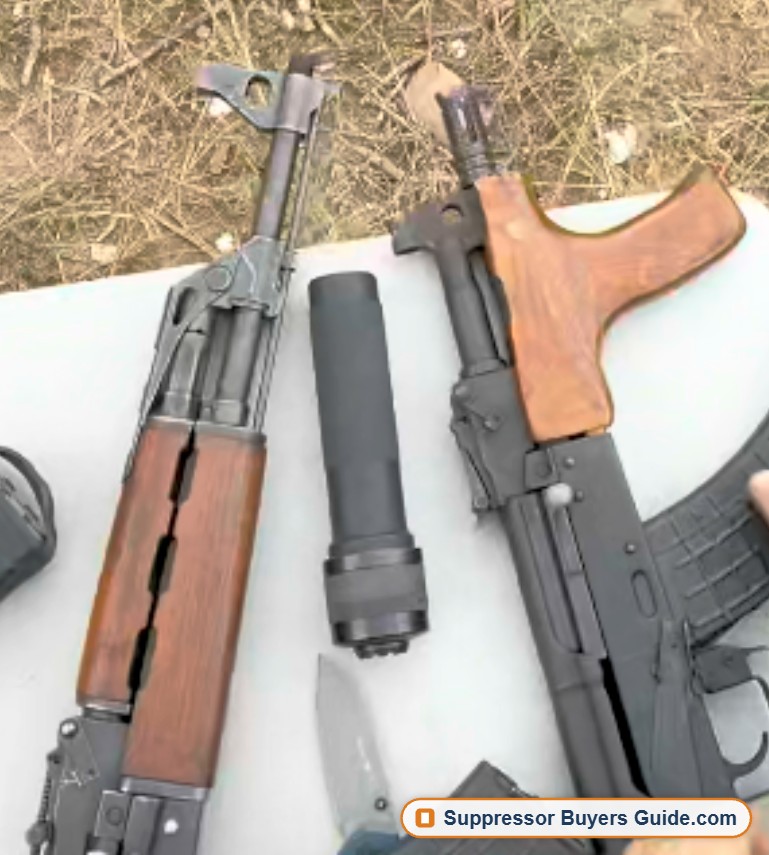
There is another problem that became especially important outside Soviet military production: muzzle alignment.
Many AK-pattern rifles were manufactured in different countries, factories and decades using numerous barrel dimensions and muzzle thread standards. The relationship between those threads and the actual bore is not always as precise as would be expected from a rifle specifically designed for suppressor use.
A short muzzle brake can tolerate some misalignment. A long suppressor cannot.
This is one reason both historical and modern AK suppressors often have comparatively generous internal clearance.
The AK-74 Changes the Problem
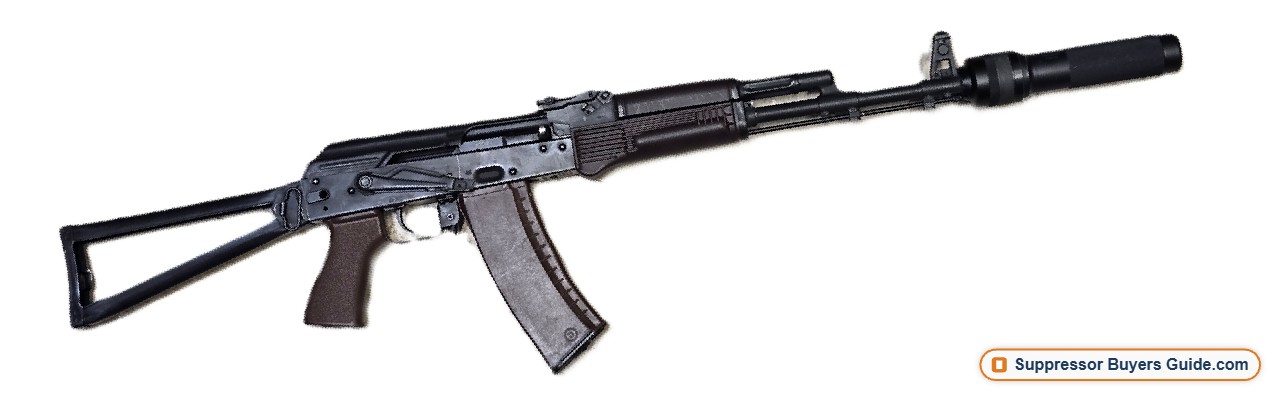
The Soviet adoption of the AK-74 and its smaller 5.45×39 cartridge during the 1970s created a new challenge.
The existing PBS-1 system had been developed around 7.62×39, and there was not immediately an equivalent suppressed system available for the new rifle. As a result, suppressed 7.62×39 AKM and AKMS rifles remained useful even after the Soviet military had begun transitioning toward the AK-74.
Eventually specialized 5.45×39 suppressed systems appeared.
One of the best-known combinations became the AKS-74UB paired with the PBS-4 suppressor and specialized subsonic ammunition. This represented another step toward treating the rifle, ammunition and suppressor as a coordinated system rather than simply attaching a silencer to an ordinary service rifle.
PBS-4 and Later Soviet Development
The PBS-4 is particularly associated with the compact AKS-74U family.
By this point Soviet suppressor development had progressed considerably beyond the original 1950s experiments. The smaller-caliber system allowed specialized troops to retain the compact Kalashnikov operating system while reducing muzzle flash and sound signature.
The PBS family also illustrates an important feature of Soviet weapons development: suppressed Kalashnikovs existed alongside purpose-built silent firearms rather than replacing them.
Weapons such as the AS Val, VSS Vintorez and other specialized suppressed systems eventually offered capabilities beyond what could reasonably be achieved by adapting a standard AK. The Kalashnikov nevertheless remained attractive because it was already familiar, rugged and widely available.
Shop AK gear
We may earn a commission from these links at no cost to you. Learn more.